This article was originally published on LinkedIn.
On the first day of our Walton MBA - University of Arkansas Leadership and Organizational Behavior course, Matt Waller and I asked the room to raise a hand if they consider themselves self-aware. Almost every hand went up. Then we shared what organizational psychologist Tasha Eurich found across ten studies with about 5,000 people. Nearly everyone in those studies believed they were self-aware. When her team measured it, only 10 to 15 percent actually were.
That gap is one of the biggest obstacles in leadership development. It's also why we spend Week 1 studying the one leader our students will spend the most time with for the rest of their careers: themselves.
Why the leader comes first
We teach leadership as a system with three parts: the leader, the followers, and the situation. We study all three through a semester-long case study on Walmart. Walmart is a living leadership laboratory. It’s the world’s largest retailer whose story runs through Walton’s Five and Dime on the Bentonville square and whose leaders are a short drive from our classroom. Week 1 belongs to the leaders our students are, and the leaders they strive to be. Before our students study how leaders behave, or how followers and situations shape what style of leadership works, they need an honest read on their own attributes.
What the research says
The Big Five Personality Model is one of the most validated personality frameworks in psychology. It sorts personality into five broad traits that show up across people and cultures: openness to experience (curiosity and comfort with new ideas), conscientiousness (discipline and follow-through), extraversion (energy and assertiveness around other people), agreeableness (warmth and cooperation), and neuroticism (how strongly you react to stress, with emotional stability at the other end). Each trait is a range, and everyone lands somewhere on all five.
In a 2002 meta-analysis, Timothy Judge and his colleagues found that the Big Five personality traits predict leadership, with extraversion and conscientiousness the strongest of the five. Interestingly, extraversion predicts who gets noticed as a leader better than it predicts who leads well. Plenty of outstanding leaders are introverts.
There is also no perfect personality profile. Conscientiousness gives you hard work, a focus on details, and follow-through, but pushed far enough it can lead to rigidity and perfectionistic tendencies. Neuroticism represents the experience of negative emotions, but a little of this might help identify the flaws in an idea. All traits have trade-offs. So the message we give our students is that awareness of your personality profile is more important than the profile itself. That awareness will help them leverage their strengths and mitigate their weaknesses in the moments that matter most. And research shows that personality is less fixed than most people assume, so Matt and I built a semester-long challenge to help our students fine tune their personality profiles.
The personality report
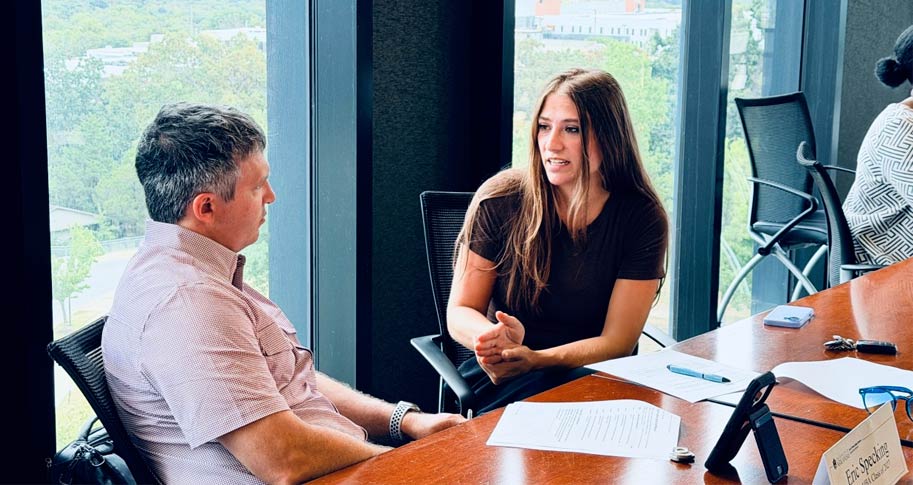
Before the first class, every student completes a Big Five assessment, and we produce a custom report for each of them. It assigns them to one of 243 unique personality profiles (for example, The Charismatic Connector), lists strengths and growth areas, describes how the student tends to respond under stress, and closes with a "Working With You" section for their teammates, which we’ll dig into later in the semester during our Leading High-Performing Teams module. In class, students paired up with a classmate, shared some of the findings in their report, including their profile name, one strength that resonated with them, and one growth area that stung a little because they know it’s true.
The values exercise
We also ran a values exercise, and we did so prior to covering the personality traits. Values are what we protect. Traits are how we tend to show up while we’re protecting them.
The exercise comes from Adam Galinsky at Columbia Business School, who gives it to his MBA students in their first week and describes it in his outstanding book Inspire. Students list up to five values and challenge each one: is this something I really value, or something I think I’m supposed to value? They rank them, with the value they'd protect above all others at the top. Then they write the short story behind their top value, where it comes from and the last time it influenced a decision in their lives.
The exercise is backed by research. Galinsky and colleagues asked newly unemployed people in Switzerland to spend ten to fifteen minutes reflecting on their values. A month later, that group was about three times as likely to have found a job. Reflecting on what you stand for steadies you when things get hard.
Perhaps the most interesting part of class came when students put the two components together. Where does your personality make your top value easy to live out, and where does it fight it? If your top value is honesty and you're high on agreeableness, those two will collide, and I can tell you where: feedback conversations. Knowing that ahead of time can be a real advantage.
Walmart leaders through this lens
Sam Walton's autobiography, Made in America, was our students' first reading of the semester, and his attributes are in every chapter. In 1940 he took a job at a J.C. Penney store in Des Moines for $75 a month, and a company auditor told him he might not be cut out for retail because his paperwork was so bad. Sam Walton, not cut out for retail? Ha!
He read about two Ben Franklin stores in Minnesota that had gone to self-service and rode a bus all night to see them. When he lost the lease on his Newport store in 1950, he moved to Bentonville and started over. Each of those stories maps onto a trait our students had just seen in their own reports.
Doug McMillon, who handed the CEO role to John Furner on February 1, began as a summer associate unloading trucks in a Walmart distribution center. Early in his time as CEO he listened to associates tell him what needed to change, and in 2015, based on what he heard, he announced higher pay and new training. That is empathy, one of the core competencies the students studied this week, put to use at scale.
Furner started in 1993 as an hourly associate in a Walmart garden center. In a 2024 interview he said it's important to recognize who you are and what you bring, and that it cannot be everything. This summer he told Walmart's interns to figure out what they care about most and let it guide their decisions, and he learned his own values watching his dad work at the company. Our MBA students had just spent an hour following Furner’s advice.
Both classes also heard from Walmart leaders in person: Our full-time MBA students heard from Julie Royall, Market Manager. And our Executive MBA students heard from two speakers: Lance de la Rosa, EVP, Northeast Business Unit and Kurt Templeton, Senior Director of the Walmart Museum and Heritage Group. All three speakers were outstanding.
The readings
Along with Made in America, students read "Emotional Intelligence Has 12 Elements. Which Do You Need to Work On?" by Daniel Goleman and Richard Boyatzis. It sorts emotional intelligence into four domains and twelve competencies, and it set up the question that opened the day. Which competency supports all the others? Self-awareness. Without it, the rest don't have solid ground to stand on.
What Week 1 sets up
Students walked out of their first class with a custom personality report, a ranked list of values and one tension to watch between their values and their traits. Week 2 turns to leader behaviors. Their 360 feedback will add an outside view later this fall, and fair warning to my students: this feedback is where the surprises (and the transformative growth) live. The results of the values exercise will return when they build their Leadership Development Plan in a few weeks.
“Better leaders. Stronger teams.” That's our course tagline, and it all starts with creating self-awareness of the leaders our students are today.
This is the first in a series of articles on the Fall 2026 Walton MBA Leadership and Organizational Behavior course.