This article was originally published on LinkedIn.
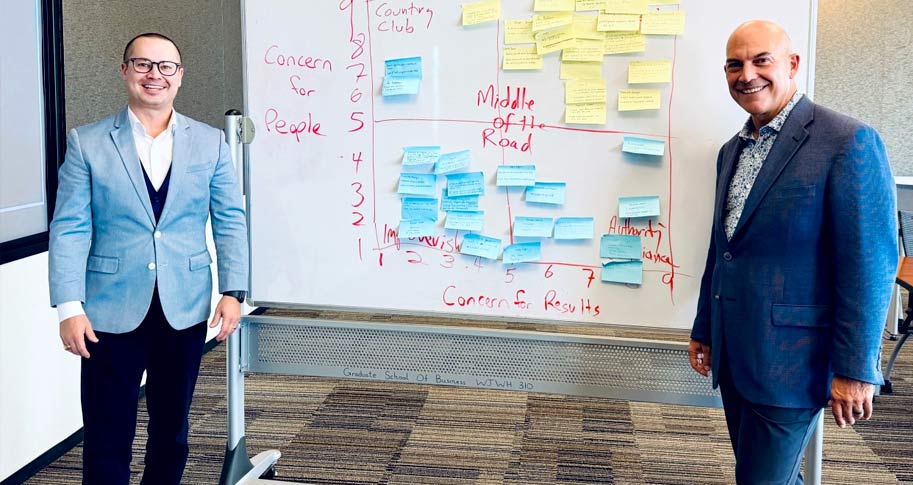
In week 2 of our Walton MBA - University of Arkansas leadership course, Matt Waller and I asked our students to think of the best leader they had ever worked for and write down two or three things that person did that make them great. Then the worst leader, same drill. Best leaders went on a yellow sticky note and worst on a blue one. We then asked them to plot both leaders up on a grid on the whiteboard. Along the bottom: The leader’s Concern for Results. Up the side: Their Concern for People. By the end, the yellow notes were bunched in the top right corner of the grid and the blue notes were mostly scattered across the bottom half. It’s clear that the best leaders tend to have both a high concern for people and a high concern for results.
From who you are to what you do
Week 1 of our Leadership and Organizational Behavior course at the Walton College was about who our students are on the inside. Week 2 was about what they do, which, if you think about it, is the only part of a leader the team ever sees: whether you listened in the meeting, whether the goal you set on Monday was clear. And the good news regarding behavior is that it can be practiced and learned.
About seventy-five years ago, researchers at Ohio State collected thousands of descriptions of leaders in action and found that nearly all of them fell into two categories. Consideration covers the people side, things like listening and looking out for your folks. Initiating structure covers the results side, setting goals and holding people to them.
In 1964, Robert Blake and Jane Mouton turned those two dimensions into the grid our students were posting on. Warm and undemanding is Country Club management, where everyone is comfortable and standards slip. Demanding and cold is Authority-Compliance, where you get compliance and lose trust. High on both is Team Leadership, and decades of research support this style as the most impactful (although certain situations call for leaning more heavily on one than the other, something we’ll cover during our Situational Leadership module later in the semester).
Sam Walton lived in that top right corner. Lee Scott recalls in Made in America that Sam would show up in the drivers' break room at 4 a.m. with doughnuts (concern for people). The same man was unwavering in his effort to control expenses (concern for results).
Which one comes first
Imagine you inherit a new team, and let’s say that team has been struggling. You know both a concern for people and a concern for results are important, but which should come first? Amy Cuddy, Matthew Kohut, and John Neffinger answer this question in "Connect, Then Lead." People size up a leader on two things, warmth (can I trust this person's intentions toward me) and competence (can this person deliver). It turns out warmth gets judged first. In a fascinating study, Jack Zenger and Joseph Folkman found that out of 51,836 leaders, only 27(!) were rated in the both the bottom quarter on likability and the top quarter on overall effectiveness. Roughly one in 2,000. It’s hard to be effective if you don’t care about people.
Nice versus good
Ron Ashkenas and Gali Cooks wrote in "Is Your Leadership Style Too Nice?" earlier this year that a lot of leaders confuse nice with good, and nice dodges the hard conversation and treats your best performer and your weakest about the same. On the leadership grid, nice without standards is called a Country Club style of leadership. Leaders should connect and earn trust, and then invest that trust raising the performance bar. Candor is kindness (a concept we’ll dig deeper into during our Difficult Conversations module later this semester).
Jim Collins found the same pairing in the leaders who took companies from good to great: personal humility combined with fierce professional will. And they tend to respond the same way when the results come in: When results are good, they “look out the window” and credit other people and luck. When results are bad, “they look in the mirror” and take responsibility. Sam Walton dedicated Made in America to his associates and wrote that much of the book is really their story (looking out the window). When he lost his first store in Newport because his lease had no renewal clause, he wrote that he blamed himself for getting suckered into such an awful lease (looking in the mirror). Think about the last time your team’s results came in. Where did you look?
The authenticity paradox
We closed with Herminia Ibarra's "The Authenticity Paradox." New behaviors often feel fake at first, so "It’s just the way I am" becomes the reason a leader doesn’t improve. So when should we be our authentic selves and when should we strive to be better? I always tell my students that if behaving in a new way goes against a core value or an important relationship, then you should avoid it and lean into your authentic self. But if the reason you choose not to behave in new ways is because it’s uncomfortable and conflicts with “the way I’ve always been,” then I encourage you to push yourself and try to grow in that area.
Heading into Week 3
Our students left week 2 with two dots on a worksheet: their own plot of where they operate under pressure (people vs. results), and where the people who know them would plot them. Each also wrote one behavior to practice under stress that moves their response up and to the right. These two plots will be helpful to them as they craft their personal Leadership Development Plan. Next week we turn to the relationships that form between a leader and each person they lead.
This is the second in a series of articles on the fall 2026 Walton MBA Leadership and Organizational Behavior course.