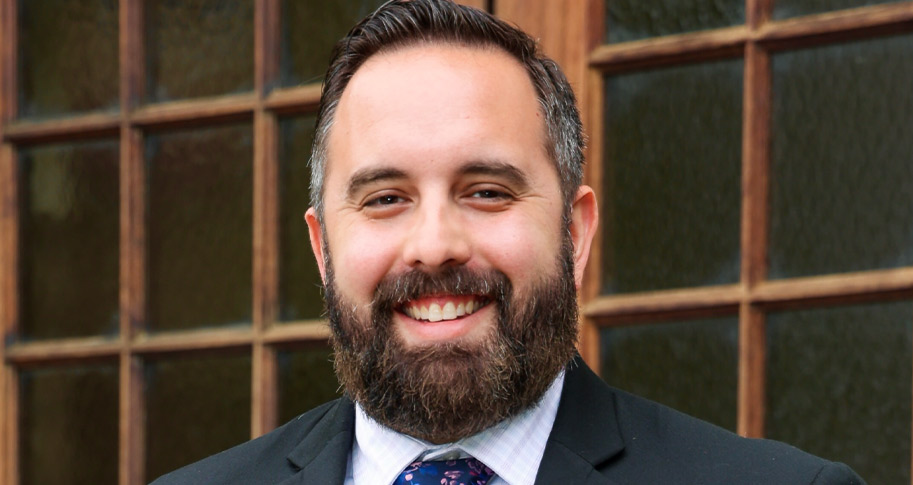



Tyler Emmett’s career spans industries and disciplines, but a consistent drive to improve systems and uncover insights shaped his path into data analytics.
After a non-traditional undergraduate experience, Emmett earned his Bachelor of Science in Business Administration in IT Management from Western Governors University in 2023, nearly 20 years after graduating high school. His professional path has spanned multiple industries and roles, ultimately leading him to the Master of Applied Business Analytics (MABA) program, where he was chosen as the 2026 Graduate Outstanding Program Scholar.
Below, he shares more about his experience in the program and his advice for others considering a future in business analytics.
Did you always plan on a career in technology?
Not at all. I often describe myself as being in my third career.
I started in lending operations within financial services, then transitioned into public service with the U.S. Small Business Administration (SBA), where I spent 15 years. While working as a commercial loan underwriter, I consistently looked for ways to improve workflows, streamline processes, and better understand the data behind decisions.
Over time, the tools and reporting solutions I built for myself began to scale to the team. That shift is what led me into technology. I spent the second half of my time there designing and managing internal software and reporting systems.
What made you choose the professional MABA program?
With my background in systems design and IT Management, I had a strong understanding of how to deploy and maintain technology solutions. However, while I enjoyed working with data, I recognized that my analytical foundation needed to be stronger.
I explored self-paced learning options, but they lacked the depth and structure I was looking for. I wanted a program that approached data holistically, grounded in mathematics, technology, and business application. The MABA program provided that balance.
What is your current job? How are you applying what you’re learning in the program?
I have been with Arvest Wealth Management for a little over a year. I operate as a full cycle data analyst, working across the entire lifecycle, from database design and data discovery to reporting, dashboard development, and recommending modeling approaches and metric definitions.
I apply concepts from the program constantly. Statistics helps me determine which signals are meaningful. Data management enables me to design scalable data structures that solve systems of problems rather than isolated requests. Data mining has strengthened my ability to extract insight when patterns are not immediately obvious. ERP concepts have helped me better understand system integration and process flow.
What are your favorite moments or memories from the program?
It is difficult to narrow it down.
One of the most meaningful aspects has been the mix of students at different career stages. I had a strong mentor early in my career, and I have appreciated the opportunity to support early-career students in a similar way.
The ERP simulation was also a highlight, creating a fast-paced environment where decisions had to be made in real time using evolving data. You get to manage a virtual company under pressure.
The program also pushed me to expand my technical capabilities, including implementing APIs, exploring AI-driven solutions, and building more scalable systems using DevOps practices.
As you approach graduation, what advice would you give to prospective or current students?
The program is designed so that you get out of it what you put into it.
There are always opportunities to go deeper, and you should take advantage of that when something sparks your interest. I also recommend documenting your learning through written reflections and applied examples. That process strengthens your understanding and helps connect concepts across courses.
The program provides the tools. Applying those tools to problems you genuinely care about is what elevates your ability to execute.
How has the program prepared you for future success?
It has fundamentally changed how I think about data and how I approach problems.
Before the program, I focused on building solutions. Now I focus on building systems that produce reliable insights. I have developed a stronger appreciation for data as a process rather than an output, where the integrity of any result is tied to how the data is structured, governed, and interpreted.
The program reinforced that data does not speak for itself. Meaning is assigned through context, assumptions, and judgment. That shift has made me more intentional in how I design analyses, define metrics, and communicate results.
It has also positioned me to operate between technical and business domains, ensuring that analytical work is not only accurate, but understandable, defensible, and actionable.
Ultimately, it has prepared me to move beyond producing dashboards and toward building systems that consistently generate insight.
**
Are you interested in building a career in business analytics? Click here for more information about the program, including application requirements and upcoming virtual information sessions.