

This article was originally published on LinkedIn.
Autonomous Distribution and the Future of Last-Mile Sustainment
Paper #4 of a Four-Paper Series
Of the three priorities that redefined contested sustainment, autonomous distribution is the most direct in its logic. The problem it solves is old: moving critical supplies to formations under active threat, across routes that may be observed, compromised, or blocked, without placing additional personnel in harm’s way. The solution it enables is new: a distribution network that operates continuously, at scale, without requiring a human in every vehicle or on every route.
Papers #1 through #3 in this series built the foundation: contested sustainment vision, AI-powered demand forecasting, and real-time asset visibility. This fourth and final paper addresses the piece that makes it all operational at the edge: physical distribution in degraded operational environments, without placing additional soldiers at risk.
THE LAST-MILE PROBLEM
The last mile of military logistics has been one of the most dangerous legs. It is where logistics transitions from managed risk to direct exposure. Convoys moving forward along predictable routes are observable and targetable. Drivers and crews face elevated operational risk. Historically, that reality constrained how aggressively commanders could sustain forward formations, forcing a tradeoff between operational tempo and the safety of logistics personnel.
Autonomous distribution changes that calculus. When a vehicle does not require a crew, the tactical decision to resupply becomes separable from the tactical risk of doing so. Commanders gain the ability to sustain tempo without a proportional increase in personnel exposure. That is not an incremental improvement. It is a structural change in how the Army fights and sustains.
WHAT COMMERCIAL INDUSTRY BUILT
The commercial industry proved the concept across a range of contexts. Autonomous aerial delivery providers operating in sub-Saharan Africa demonstrated that AI-guided fixed-wing unmanned aircraft could deliver medical supplies to remote locations without road access, using onboard AI navigation to reach precise coordinates from centralized hubs. A major consumer-goods retailer later extended the model into suburban markets, building the regulatory and operational frameworks that proved routine autonomous resupply at scale is achievable.
On the ground, commercial freight operators developed long-haul autonomous platforms that use radar and AI-driven path planning to operate on highways without a driver. Consumer goods companies added shorter-range, purpose-built autonomous delivery vehicles for urban last-mile distribution. Together, these programs demonstrated that autonomy is a spectrum rather than a single capability. The lesson was clear: autonomous distribution scales when platforms are matched to the mission.
HOW THE ARMY APPLIED IT
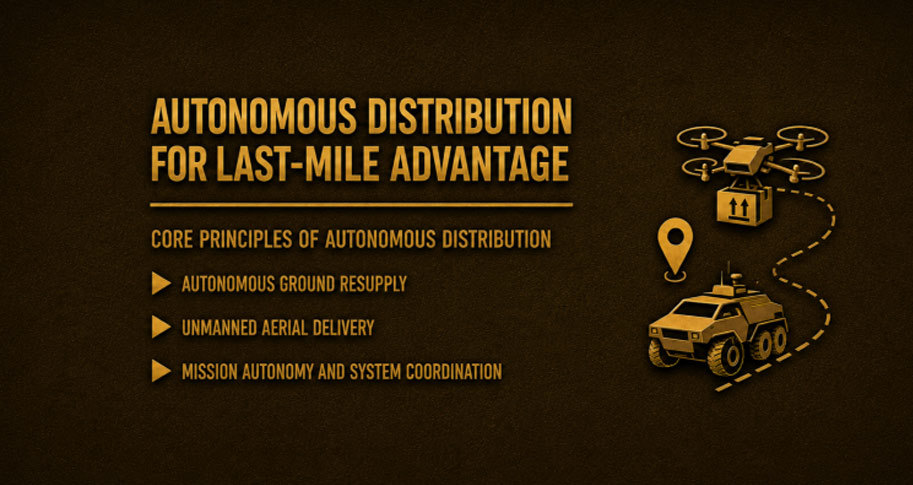
The Army’s approach mirrored the commercial insight that no single platform solves the full distribution problem. Three complementary capabilities defined the autonomous distribution architecture.
Autonomous Ground Resupply
Autonomous ground vehicles took on the highest-risk resupply runs, delivering fuel, ammunition, and water along contested routes without exposing drivers. Designed to operate in degraded communications environments, these platforms use onboard sensing and pre-loaded route intelligence to navigate without persistent connectivity. Formation-level resupply that would previously have required convoys of crewed vehicles shifted to smaller, more frequent autonomous runs, reducing the signature of each individual movement and the consequence of any single loss.
Unmanned Aerial Delivery
Unmanned aerial systems addressed the positions that ground vehicles could not reach, forward outposts, elevated terrain, and compromised locations. Medical supplies, batteries, and communications equipment were moved by air to positions that previously had to be resupplied by foot or not at all. Aerial delivery also reduced the predictability of resupply patterns, since flight paths can be varied in ways that road routes cannot, complicating targeting of the distribution network.
Mission Autonomy and System Coordination
The highest-order capability was not any single platform but the coordination between them. AI-driven logic, processing real-time sensor feeds from autonomous ground and aerial systems simultaneously, enabled distribution decisions at machine speed. A ground vehicle rerouted around a threat automatically cued an aerial system to cover the delivery, without waiting for a commander to direct each adjustment. Resupply routes are adapted in near real time to battlefield conditions. Distribution became a dynamic, AI-managed system rather than a static plan.
THE THROUGHLINE
Autonomous distribution decouples the decision to resupply from the risk of doing so. Decoupling changes what commanders can attempt, how often they can sustain forward formations, and how much operational tempo they can maintain without exhausting the logistics elements that sustain forward operations.
The commercial sector proved the concept across contexts ranging from medical delivery in sub-Saharan Africa to freight transport on American highways. The Army adapted those models for contested, degraded, and denied environments and added the coordination layer that transforms individual autonomous platforms into a coherent distribution system. What emerged was logistics in the supply chain capable of sustaining operations continuously at the pace the mission demands without increasing personnel exposure.