

This article was originally published on LinkedIn.
Asset Visibility as a Sustainment Discipline
This is the third paper in a four-part future-back series, written from the vantage point of 2035, looking backward at the choices, investments, and trade-offs that shaped how the Army solved the sustainment problem in contested environments. Each paper assumes the future has already happened and works back to the decisions that made it possible.
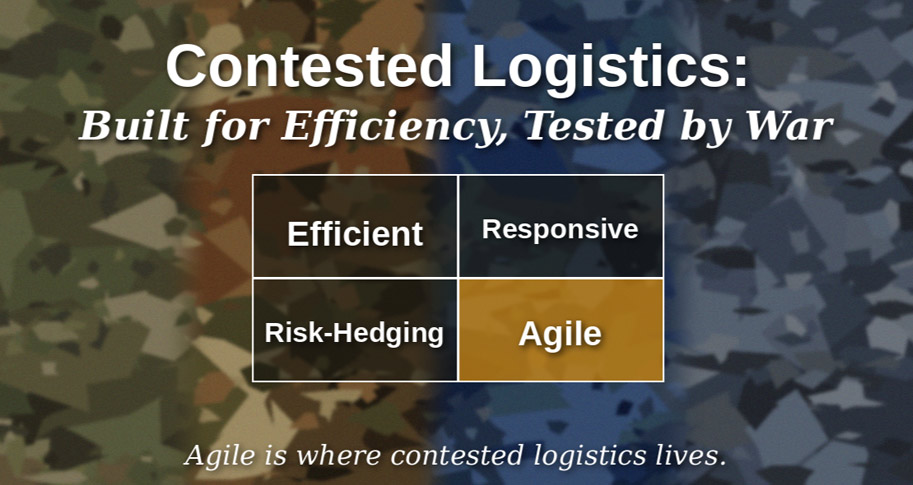
Paper #1 in this series established how predictive logistics, asset visibility, and autonomous distribution together defined the Army’s competitive edge in contested sustainment. Paper #2 examined predictive logistics in depth; this paper turns to the second domain: maintaining a clear logistics picture without becoming a target.
Supply chain visibility is, on the surface, a data problem. Know where everything is, and you can move it. But in contested environments, visibility carries a risk that commercial supply chains never face: the act of tracking can become the act of targeting. Every transmission that says the fuel trucks are here is also a signal an adversary can intercept, locate, and act on. Solving that tension is not a technology challenge alone. It is a discipline that requires redesigning how visibility works from the sensor to the screen.
This paper examines asset visibility as a priority domain in contested sustainment, tracing the commercial innovations the Army drew from and the capabilities it built to maintain situational awareness without illuminating itself to the adversary.
THE VISIBILITY PARADOX
Commercial supply chains are built on the assumption that broadcasting is safe. Retail and logistics companies transmit location, inventory, and data continuously at high frequency across open networks. That constant flow of information enables same-day delivery, real-time inventory accuracy, and dynamic routing. The more data moves, the more often it moves, the more responsive the network becomes.
In contested environments, that model inverts. High-frequency transmission becomes a signature. A predictable emissions pattern becomes a targeting cue. The adversary does not need to intercept the content of a transmission to derive value from it. The presence, timing, and origin of the signal are often enough. Visibility, pursued commercially, becomes a vulnerability. The Army’s challenge was to preserve the operational value of knowing where everything is, without creating the signatures that make that knowledge dangerous.
WHAT COMMERCIAL INDUSTRY BUILT
Leading retailers built competitive models on item-level RFID visibility across global store networks, with AI-driven demand sensing converting inventory signals into automated replenishment decisions within hours of a sale. Global freight carriers deployed multi-sensor IoT devices that transmit location alongside temperature, humidity, and shock data in near real time. Logistics providers extended this capability across pharmaceutical and cold-chain networks, using machine learning to flag condition anomalies before products were compromised. The shared advancement across all these models: visibility expanded from where it is to what state it is in, with AI processing the signals faster than any analyst could.
HOW THE ARMY APPLIED IT
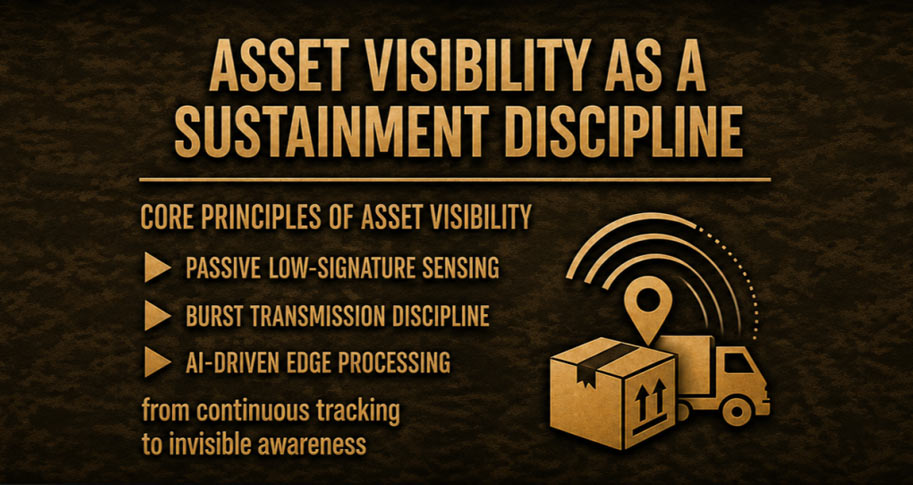
Adapting that foundation for contested environments required the Army to redesign visibility from first principles, preserving the operational intelligence while eliminating the signature risk. Three design principles governed the approach.
Passive and Low-Signature Sensing
Where commercial systems broadcast continuously, Army asset-tracking systems were engineered to listen first and transmit only when necessary. RFID and ultra-wideband sensors operate in passive or semi-passive modes, capturing location and status data locally without continuously generating an outbound signal. Sensor-equipped assets collect data at the edge, building a local inventory picture that remains accurate without real-time transmission.
Burst Transmission and Waveform Discipline
When data does move, it moves on the Army’s terms. Status updates are transmitted in short, encrypted bursts at randomized intervals using low-probability-of-intercept waveforms that are difficult to detect and harder to attribute. Transmission timing is decoupled from operational activity, removing the correlation between a unit’s actions and its communications signature.
AI-Driven Edge Processing and the Unified Logistics Picture
Position and status data are processed by AI systems at the unit level rather than sent to the rear for analysis. Machine learning models running at the tactical edge identify supply shortfalls and equipment fault patterns without cloud connectivity, keeping the logistics picture available to commanders even when links to higher echelons are degraded or lost. When windows open, processed intelligence rather than raw sensor data flows upward, reducing transmission volume and exposure time. These AI-enabled feeds integrate across echelons into a unified logistics common operating picture, giving commanders system-wide visibility without any single node continuously broadcasting.
THE THROUGHLINE
Asset visibility has always been a prerequisite for effective logistics. What changed in 2035 was the cost of achieving it carelessly. The commercial world built its infrastructure for an environment where broadcasting is risk-free. The Army built its for an environment where broadcasting is dangerous.
The discipline that emerged, passive sensing, burst transmission, AI-driven edge processing, and waveform management, did not reduce visibility. It redefined what visibility looks like when the signal itself is a liability. The Army that can see its entire logistics picture without revealing it holds a structural advantage that compounds over the course of a campaign. Commanders make better decisions. Resupply reaches the right place at the right time. The adversary never sees it coming.
LOOKING AHEAD
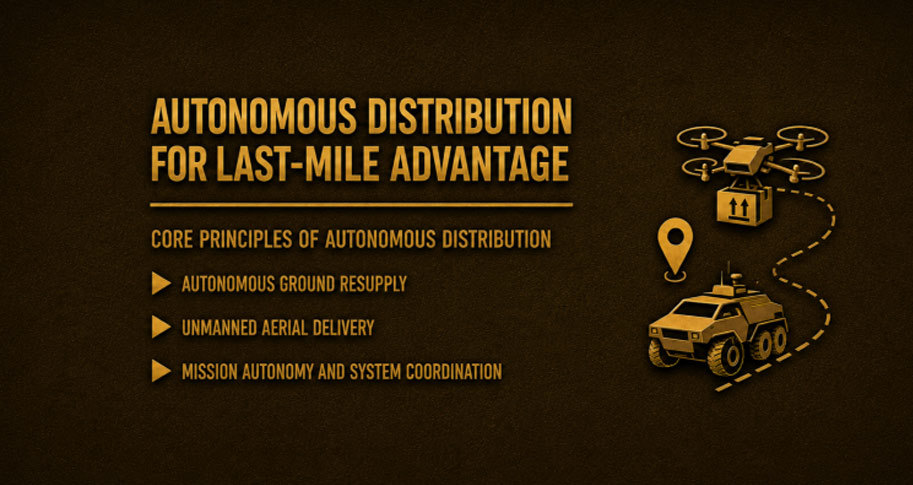
Paper #4 closes the series with autonomous distribution. It examines how the Army solved the last-tactical-mile problem when manned convoys had become predictable targets, what it took to field unmanned ground and aerial resupply at scale, and why the ability to deliver without a driver redefined which positions could be sustained, for how long, and at what risk to the soldiers holding them.