

This article was originally published on LinkedIn.
Contested Logistics Foundational Content Series
Every supply chain is built on a set of beliefs. When those beliefs change and the design does not, the supply chain breaks. That holds for a store, a plant, or a force at war.
In 1991, the U.S. moved 540,000 troops and 460,000 tons of ammo into the Gulf over five months. The ground war lasted 100 hours. The supply chain worked because the setting let it: open ports, safe sea lanes, five months to stage, one front. It fit the world it served.
In March 2023, the Marine Corps rewrote its logistics doctrine for the first time in 26 years. The new MCDP 4 changed the premise. Supply lines are now at risk on land, sea, air, space, and cyber. Marines must ship and fight at the same time, in every domain. No staging time. No safe ports. The fight has changed. Has the supply chain changed with it?
Why does the legacy defense supply chain design fail under contested logistics?
The old defense supply chain was tuned for cost under safe skies: long plan cycles, central depots, single-source deals. A contested fight breaks all of them at once.
That design served the force for decades. Stable demand, safe sea lanes, and months of warning let planners chase price per unit. A contested fight removes all three. A 2025 Defense Business Board study identified six areas where defense supply chain practices trail private sector standards, each tracing to the same root: a system designed for efficiency when the environment was stable.
How do you design a supply chain for contested logistics?
You design it to hold cost and surge inside one system, because a contested fight puts both demand and supply at risk, and no single posture covers both.
The design mismatch is a known problem. Fisher asked the key question in 1997. What is the right supply chain for your product? His answer turned on demand. Stable demand calls for an efficient supply chain built on low cost and high flow. Wild demand calls for a responsive supply chain built on speed and flex. When the design and the demand do not match, the supply chain is the thing that gives.
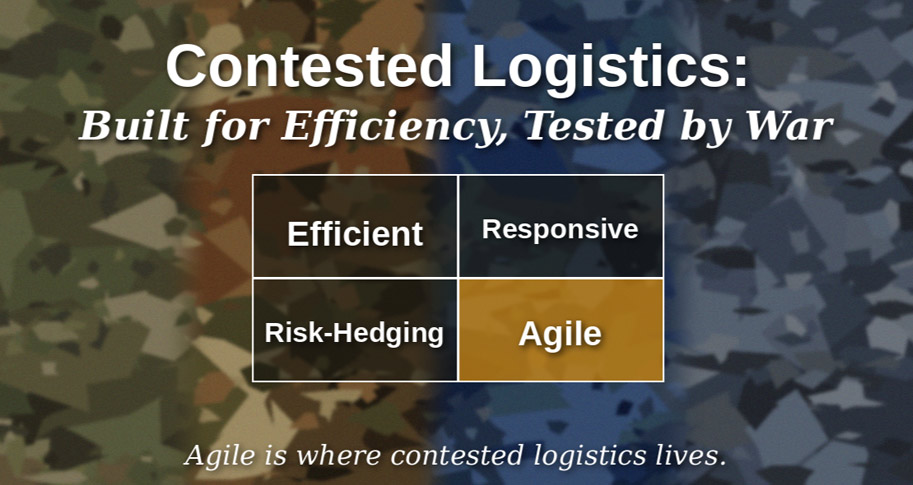
Hau Lee added the next layer. Supply can be at risk too, not just demand. That opens four options:
- Efficient: low cost and high flow, but brittle when demand spikes or supply gets cut.
- Risk-hedging: buffers against supply shocks, but slow to shift when demand changes.
- Responsive: fast and flexible, but expensive to hold when things are calm.
- Agile: fast and shock-proof, and the hardest to build.
Agile is where both demand and supply are at risk at the same time. That is where contested logistics lives. It requires designing and executing for both/and, not either/or.
How does Toyota illustrate the both/and model for contested logistics?
Toyota runs an agile supply chain; the real form of lean. After the 2011 quake it told suppliers to stockpile key parts for two to six months, and in 2021 it sold 10.5 million units while rivals cut output.
Lean got shrunk to a “cut all stock” myth, but Toyota’s supply chain did not last through the 2011 quake, the 2020 COVID shock, and the 2021 chip crisis by cutting stock to the bone. It paired low cost with the power to take hits. Most firms that slid in 2020 to 2022 had supply chains built for calm. The crisis exposed weak spots that were there all along.
Mentzer, Stank, and I tested this in 2010 in the Journal of Business Logistics. The either/or frame is false. The best firms blend cost, service, and speed at the same time.
Why can’t the military switch supply chain designs the way companies do?
A firm can shift from low-cost to high-speed over months or years. The military has to carry both at all times: inexpensive enough to clear peace budgets, fast enough to surge when the fight starts.
A review of 186 papers on military supply chains reached the same point. The force cannot toggle between cost and speed. It must run both inside one system, and the price of forgetting has been steep.
Van Creveld’s study from the Thirty Years’ War to Patton showed that supply failures shaped more campaigns than enemy action ever did. Napoleon won in 1805 when his design fit the fight, and lost in 1812 when it did not.
What is the design task ahead for contested logistics?
Build a supply chain that runs efficient in peace and fast in war, with the warfighter as the customer at the end of every line.
DLA has moved in this direction, shifting past “just-in-time” to a “just enough” model led by AI. Its new Warehouse Management System has replaced old platforms at most of its 24 sites, a move the commander framed as being able to adapt over raw speed or raw thrift. I call it “just right,” and it is what Toyota’s lean has been all along.
Contested Logistics: What is It? showed that military logistics and supply chain management face the same problems from different starts. Contested Logistics: Why It Matters showed the stakes. When the Supply Chain Is the Battle showed those stakes have real consequences. The tools and the skills exist. The work is to join those views on a shared task.
Sources
AUSA. “Operations Desert Shield and Desert Storm: The Logistics Perspective.” 1991. ausa.org
Headquarters Marine Corps. MCDP 4: Logistics. Revised March 2023. marines.mil
Marshall L. Fisher. “What Is the Right Supply Chain for Your Product?” Harvard Business Review. March-April 1997. hbr.org
Hau L. Lee. “Aligning Supply Chain Strategies with Product Uncertainties.” California Management Review 44, no. 3 (2002): 105-119. sagepub.com
Martin Christopher and Denis R. Towill. “Supply chain migration from lean and functional to agile and customised.” Supply Chain Management: An International Journal 5, no. 4 (2000): 206-213. emerald.com
Harvard Business Publishing. “Toyota’s Disrupted Global Supply Chain: COVID-19 and the Global Chip Shortage.” Case TB0648. hbr.org
Toyota Motor Corporation. “Sales, Production, and Export Results for 2021.” global.toyota
Brian S. Fugate, John T. Mentzer, and Theodore P. Stank. “Logistics Performance: Efficiency, Effectiveness, and Differentiation.” Journal of Business Logistics 31, no. 1 (2010): 43-62. wiley.com
Martin van Creveld. Supplying War: Logistics from Wallenstein to Patton. Cambridge University Press. 1977.
David Loska, Benjamin Hazen, Nicholas Rich, Stefan Genchev, and Tegwen Malik. “Military Supply Chain Logistics and Dynamic Capabilities: A Literature Review and Synthesis.” Transportation Journal 64 (2025): e70002. wiley.com
Defense Logistics Agency. “Just Enough Logistics Shifts Paradigm in Military Supply Chain Readiness.” DLA News. December 2025. dla.mil
Defense Business Board. Supply chain alignment study. January 2025. dbb.defense.gov