

This article was originally published on LinkedIn.
A Vision-Back Narrative
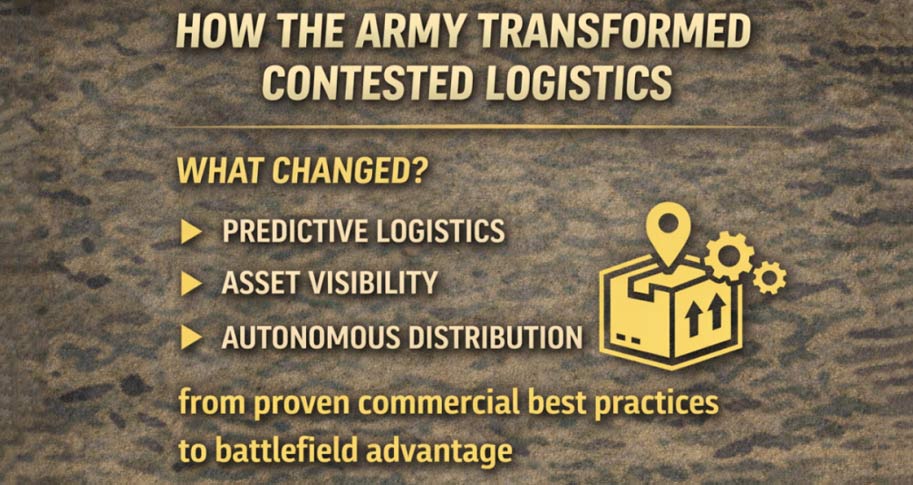
The year is 2035. A US-led coalition has successfully prosecuted a contested, multi-domain campaign across the Pacific theater. The outcome did not turn on firepower alone. The Army successfully sustained itself when adversaries made sustainment a target and reimagined how supply chains must operate in modern contested environments. This paper looks back at the pivotal decisions the Army made to achieve that outcome. Three priorities defined the transformation: predictive logistics, asset visibility, and autonomous distribution. Together, they enhanced the Army’s competitive edge in contested sustainment.
THE ENVIRONMENT THAT SHAPED THE STRATEGY
By the early 2020s, Army leadership had mapped the operating conditions that would define success in future engagements. Four realities shaped the strategic direction.
1. Attrition Is Expected
Modern large-scale combat operations demand resilience at every layer of the supply chain. Forward support elements must be designed to sustain the fight through disruption, which means pre-positioning, built-in redundancy, and autonomous alternatives are baseline capabilities, not add-ons. The force that plans for continuity under pressure is the force that maintains the initiative.
2. Communications Will Degrade
Adversary electronic warfare capabilities operate at an operational scale, making signal resilience a design requirement rather than an afterthought. Logistics systems engineered to function in degraded and denied communications environments provide the Army with enduring capability precisely when it is needed most.
3. Visibility Cannot Become A Target
Knowing where supplies are is essential to logistics coordination. Achieving that visibility without creating a detectable emissions signature requires disciplined design. Signature management and supply chain visibility are complementary disciplines, and the Army treated them as such.
4. Energy Burden Is First Order
Modern platforms, sensors, and communications systems make energy management a frontline logistics priority. Managing the full energy picture (e.g., fuel, batteries, microgrids, and hybrid drives) requires a new generation of planning and distribution tools. The Army invested in that capability, treating power as a warfighting variable with the same rigor applied to ammunition and water.
THREE PRIORITIES THAT CHANGED THE EQUATION
The Army’s response was deliberate and focused. Leadership identified three must-get-rights with the highest operational return and moved with purpose, drawing on proven commercial models.
1. Predictive Logistics
The foundational shift was from reactive to anticipatory. Leading global retailers had spent many years building demand forecasting engines that triggered replenishment automatically across global networks before shortfalls occurred. Leading consumer packaged goods (CPG) companies pioneered collaborative planning and replenishment frameworks that raised service levels while reducing inventory burden. The Army applied the same logic to warfighting: using platform health data, consumption history, and mission variables to pre-position supplies and initiate resupply before units felt the need. By 2030, AI-driven systems were running inference at the tactical edge without cloud connectivity, flagging maintenance faults hours or days before mission-critical failures occurred and triggering resupply actions ahead of demand.
2. Asset Visibility
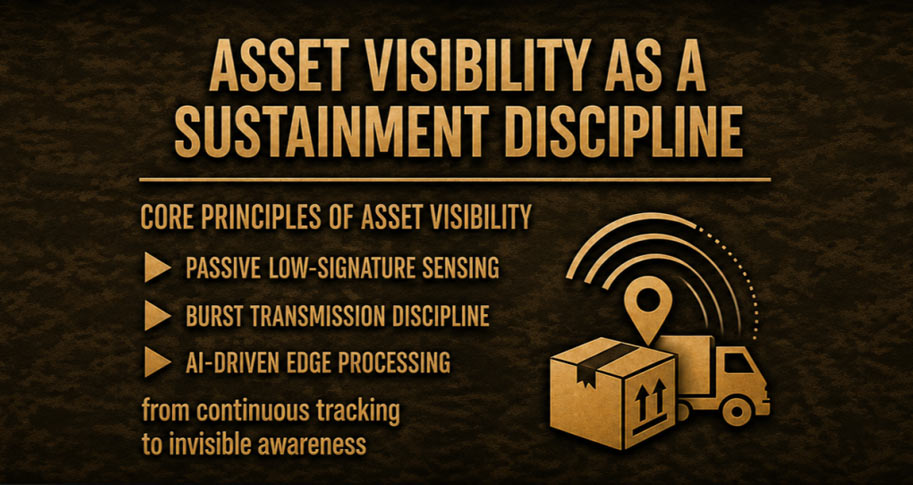
Visibility without signature became the governing design principle. Commercial industries and conglomerates had built global supply chains on item-level RFID and real-time location data. The Army adapted that capability for contested environments with a hard constraint: sensors had to be passive where possible, encrypted at all times, and intermittent by design. Integrating data across organizational boundaries enabled a unified logistics intelligence picture that no single unit could have produced on its own. Position data was processed locally and shared only when operationally necessary, using low-probability-of-intercept waveforms that kept the logistics picture visible to commanders and invisible to adversaries.
3. Autonomous Distribution
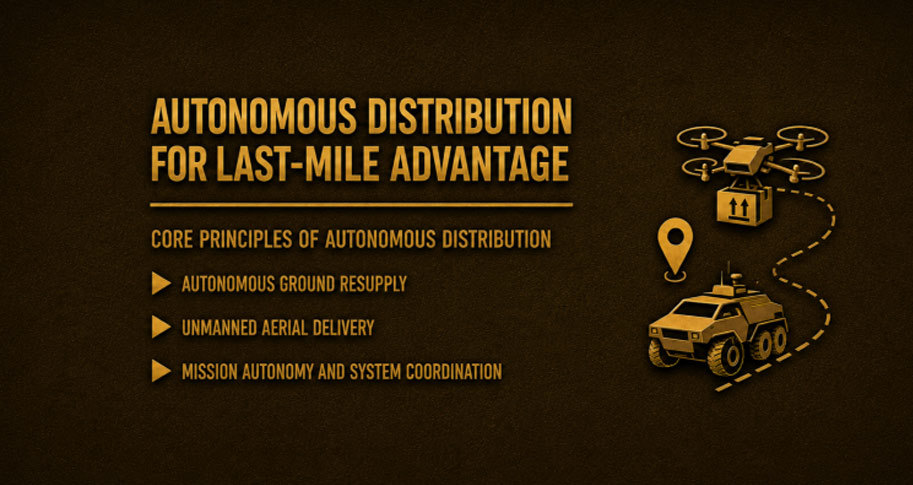
The Army recognized that autonomous distribution would multiply the effectiveness of available personnel, enabling continuous, multi-node resupply at a tempo and scale that manual systems alone could not sustain in large-scale combat. The commercial model was already proven. Leading mass merchandisers and retailers had built networks of smaller, more agile distribution nodes linked to on-demand delivery, micro distribution centers dispatching small quantities continuously to multiple locations. The Army applied that model under fire. By the early 20230s, autonomous ground vehicles were delivering ammunition and fuel on contested routes. Unmanned aerial systems reached positions no vehicle could access. Resupply was decoupled from human exposure and the risk calculus that had historically constrained commanders’ options.
THE THROUGHLINE
What made this transformation possible was a combination of innovative technology, organizational agility, and a culture of accountability. These elements, combined, created a superior platform. The Army moved with urgency, integrating data across systems, fielding capabilities at an operational scale, and trusting AI-driven tools to operate at the pace the battlefield demands. The governing principle was clear: speed wins. The Army that sustained itself best in 2035 did so not because it had more, but because it anticipated, adapted, and moved at a pace its adversary could not match. In contested sustainment, that edge was decisive.
####
This paper is the first in a four-part series. Papers #2–#4 go deeper into predictive logistics, asset visibility, and autonomous distribution, respectively.