One year. Real impact. Advance your career.
Designed for ambitious professionals seeking leadership development, career advancement, and direct access to the Fortune 500 business ecosystem of Northwest Arkansas. Fully funded tuition. Fully immersive.
What Alumni Say

“I feel even more motivated to approach my work with curiosity, empathy, and a global mindset.”
Stella Myers, '26
Category Analyst · PepsiCo Walmart Advisor Team

“It equipped me with a diverse skill set, an important professional network, and a problem-solving approach.”
Ayden Owens, '23
Founder & CEO · DapUp

“This program has connected me with great friends, mentors, and knowledge that has set me up for success.”
Hailey Schneider, '26
Sr. Customer Development Analyst · Kenvue
Program Accolades

The Walton MBA Advantage
- One-year accelerated format
- Fully funded tuition - graduate assistantships
- Access to Fortune 500 business ecosystem in NWA
- Applied and experiential learning
- Leadership and career development
- Global immersion
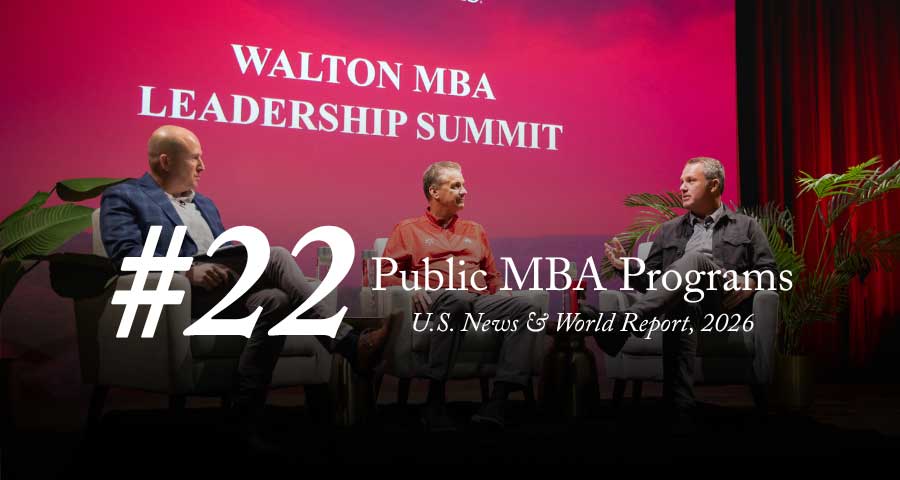
- #22 Public MBA Program from U.S. News & World Report
- Strong alumni network and mentorship
Career Outcomes & ROI
Where a Walton MBA takes you
Our graduates move fast — into new industries, leadership roles, and organizations that shape the global economy.
Key outcomes
92%
employed within 90 days
Top employers
- Walmart
- Tyson Foods
- PepsiCo
- McCormick
- Deloitte
- Henkel
- Rich Products
- Sam's Club
- Unilever
Program Length
August – June
MBA students complete 38 credit hours with their cohort. The curriculum combines a focus on core coursework with electives and professional development programming.
Application Deadline
February 15
February 15 is the international and priority deadline date. June 1 is the final deadline. Applications completed after the February 15 priority deadline are subject to cohort availability.
Start Date
Fall
Entrance Test
GMAT or GRE
A GMAT or GRE score is required, but can be waived for applicants with 2+ years of post-bachelor’s professional work experience. Please review our master’s admissions policies.
Additional expenses include, but are not limited to, Books, Housing, Laptop, and Parking.
*Estimate based on actual May 2026 trip cost.
**Stipend paid based on actual weeks worked as a graduate assistant. Can vary by student plan.
Financial Assistance
Paying for Graduate School
In addition to fully-funded tuition and the Graduate Assistantship stipend, financial support may also be available through scholarships and/or financial aid.
Curriculum
Courses & program schedule
Every course is designed around what you’ll actually do with it.
Core Curriculum
MGMT 56103: Leadership and Organizational Behavior - Managing in a global workforce, including human resource issues, motivation, performance evaluation, quality concepts, transformational leadership, and selection/ recruitment/ development of employees.
ISYS 53603: Business Analytics - This course in managerial business analytics provides future managers with the key concepts of decision modeling and information technology management concepts. Students will learn to utilize real time operational business data, as well as quickly process and effectively leverage information. In addition, students will exercise strategic IT deployment skills for supply chain and marketing processes as well as develop strong decision modeling abilities.
BADM 5370V: Special Topics - Artificial Intelligence for Business Leaders helps students undertand and apply AI within their workplace. This hands-on course explains how AI tools work, what they do well, and where they fall short. As AI changes the way work is conducted, students learn to identify practical AI opportunities, enhance their own performance, and advance the strategy of their organizations.
FINN 51103: Corporate Financial Management - Financial analysis, planning and control; decision making and modeling for financial managers; and financial policies for management. Prerequisite: Graduate standing in the Master of Science in Finance program.
ACCT 52203: MBA Accounting Analysis - Highlights the role played by accounting information in managing supply chains and retail operations. Provides tools for managing cost flows, including activity-based costing, retail accounting, and operational budgeting. Focuses on improving decision making processes, and linking the impact of retail/supply chain decisions to financial statements and shareholder value.
MKTG 52203: Marketing - Product management, market research, marketing communications, retailing and distribution, consumer behavior, and social and ethical implications of marketing.
SCMT 56303: Foundations for New Product Launch and Integrated Demand-Driven Value Networks - Supply chain management is the integration of key business processes from end user through suppliers. The focus of this course is on the business fundamentals and core processes that must be linked throughout the supply chain in order to ensure the effective development and delivery of products and services that satisfy customers.
ECON 52403: Managerial Economics - This course will provide students with a strong foundation in core economics principles, with emphasis on industrial organization issues and applications geared toward the supply-chain and retail focus of the redesigned MBA program.
SEVI 53103: Strategic Management - Strategy formulation, strategy implementation, and other topics related to the long-term success of the firm. Includes role of the general manager, international issues, and the impact of management fads on decision making.
BADM 5530V: Global Business - Provides MBA students with the opportunity to explore a business problem in depth under the guidance of a graduate faculty member.
BADM 55101: Professional Development - Special Topics in Business (students must repeat course for a total of 2 hours) - A concentrated emphasis on one business topic. Corequisite: MGMT 56103, ACCT 52603 and ECON 52503.
Full-Time MBA — Program Schedule
Focus Areas
What are the MBA electives you can select?
- Business Analytics, Digital Innovations, Finance, Negotiations, Organizational Innovation, Retail Marketing, Supply Chain Management
Integration of AI
How AI is integrated into courses
- AI is integrated throughout the curriculum, giving students hands-on experience using emerging technologies for business analysis, strategy and decision-making across disciplines.
Student Experience
How is career development built into the Walton experience?
Career support is an integral component to the Walton student experience.

Career coaching
One-on-one coaching from advisors who know the Northwest Arkansas business landscape.

Networking opportunities
Direct access to Fortune 500 recruiters and alumni.

Resume and interview prep
Hands-on preparation for every recruiting conversation.
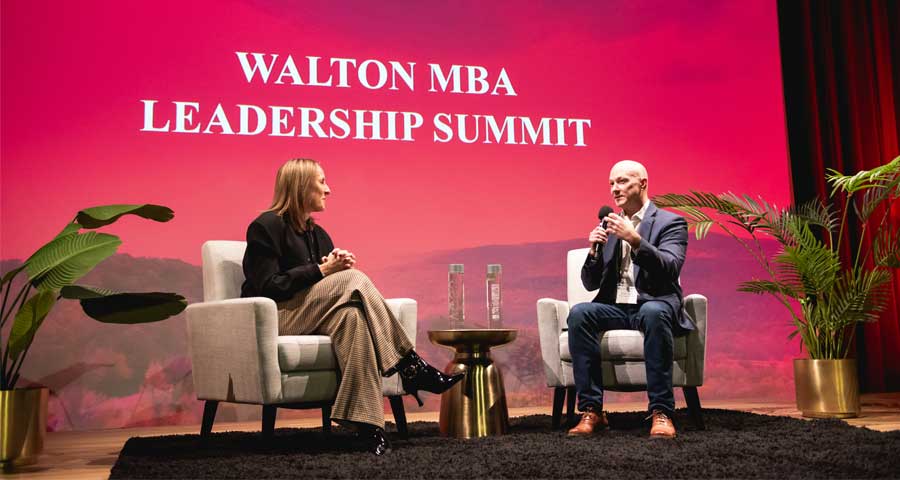
Leadership development
Structured opportunities to build leadership from day one.
Program Fit
What makes you a competitive candidate for this program?
The Walton full-time MBA is a small, collaborative cohort that offers fully-funded tuition through graduate assistantships. Admissions consideration is highly competitive.
Do you have work experience?
The Walton full-time MBA gives priority consideration to candidates with prior full-time work experience.
Do you have clear career goals?
Being able to clearly identify and explain your career goals and how the Walton MBA program can help you accomplish them is a differentiator in the selection process.

Student Voice & Proof
Inside the Walton MBA experience
Stories and perspectives from students, alumni, and faculty — straight from the program.
News & Noteworthy — MBA Insider
FAQ
Frequently asked questions
Everything you need to know before you apply. Don't see your question? Reach out to the graduate programs office.
Admitted Walton Full-Time MBA students who are awarded a competitive, merit-based graduate assistantship will receive a full tuition waiver. The assistantship also provides an estimated gross stipend of $20,674.50 over the length of the program in exchange for a 20-hour-per-week work appointment.
Published tuition and fees before graduate assistantship funding: $30,093.72. See the complete calculation below.
*Domestic students who enroll in the university health plan should budget an additional estimated $1,045. With university health insurance, estimated direct program expenses are $16,211.14. Housing, food, books, a laptop, parking, local transportation, and other personal expenses vary by student and appear separately in the university’s cost-of-attendance estimate.
**Estimates use 2026–27 approved tuition and fee rates and the May 2026 Global Immersion cost. Tuition, fees, insurance premiums, travel costs, and assistantship compensation for the Fall 2027 cohort are subject to change. The stipend is gross compensation for a 20-hour-per-week appointment. Actual take-home pay depends on taxes and payroll deductions. Graduate-assistantship funding requires continued fulfillment of appointment, enrollment, academic, and employment requirements.
Throughout the program, students complete coursework in:
- People Management, Ethics and Leadership
- Information Technology and Analytics
- Accounting and Financial Capital
- Marketing and Supply Chain Management
- Strategic and International Management
- Professional Development
Students can also tailor their MBA through electives in:
- Business Analytics
- Digital Innovations
- Finance
- Negotiations
- Organizational Innovation
- Retail Marketing
- Supply Chain Management
AI is integrated throughout the curriculum, giving students hands-on experience using emerging technologies for business analysis, strategic thinking, and decision-making across disciplines.
If you're looking for an intesive, immersive MBA experience designed to accelerate or pivot your career, the Full-Time MBA is likely the best fit. If you want to continue advancing your career while earning your MBA, the Executive MBA offers a flexible hybrid format designed for working professionals.