




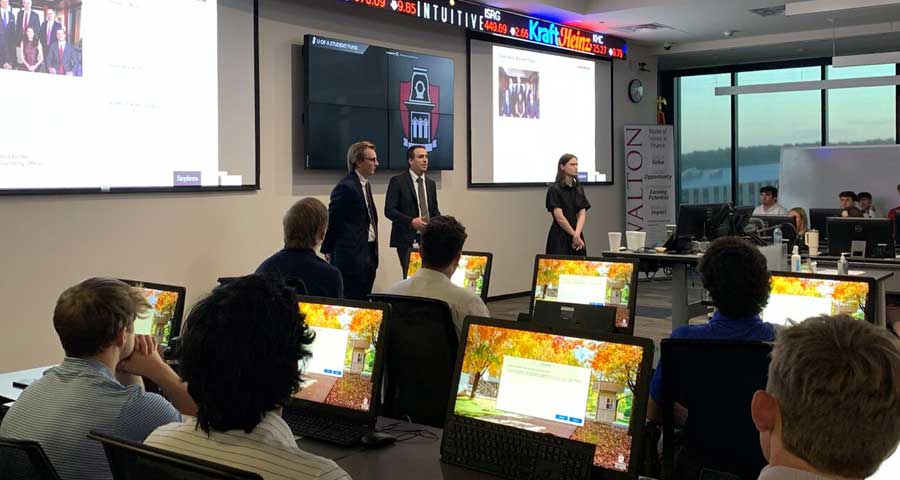

Master of Science in Finance

Innovative. Impactful.


The Walton Master of Science in Finance is a full-time program, usually completed in one year, for recent graduates and early-career candidates who want advanced, hands-on finance training.

What Alumni Say

Cole Parton

“The curriculum for this degree is rather flexible and allows students to home in on topics that interest them.”

Cole Parton, '24

Senior Manager · Enterprise Strategy and Market Intelligence · Walmart

William Tier

“I wanted to deepen my knowledge in finance while specifically strengthening my understanding of private market investing, valuation, and decision-making.”

William Tier, '26

Venture Associate · Capital Factory

The Walton Advantage

  • Accelerated 30-credit-hour format with fall and spring start options
  • Comprehensive curriculum spanning corporate finance, investments and financial markets
  • Advanced training in financial modeling, analytics and AI, Python and SQL
  • Applied learning through valuation projects and portfolio management
  • Access to Walmart, Tyson Foods, J.B. Hunt and Northwest Arkansas' broader business ecosystem
  • Competitive tuition and funding opportunities, as well as internship-friendly scheduling
  • A 4+1 pathway that lets Walton undergraduates take up to six graduate credit hours at the undergraduate tuition rate
  • Strong alumni connections, professional mentorship and personalized faculty support

Career Outcomes

Where a Master of Science in Finance takes you

Our graduates move fast — into new industries, leadership roles, and organizations that shape the global economy.

Master of Science in Finance

Career Paths

  • Financial Analyst
  • Investment Banking Analyst
  • Financial Consultant
  • FP&A Analyst
  • Credit Analyst
  • Risk Analyst
  • Investment Analyst
  • Financial Data Analyst

Where Our Graduates Work

  • Walmart
  • Tyson Foods
  • J.B. Hunt Transport Services
  • Charles Schwab
  • Stephens, Inc.
  • William Blair
  • Northmarq
  • Concentra
Just the Facts

Program Length

30 credit hours

Usually completed in two semesters

Application Deadline

Fall Deadlines

International applicants:
February 15
Priority (domestic applicants):
April 15
Final (domestic applicants):
July 1

Spring Deadlines

International applicants:
August 15
Final (domestic applicants):
November 1

Start Date

Fall or Spring

Entrance Test

GMAT or GRE

Applicants with an undergraduate GPA of 3.2 or higher or at least three years of relevant professional work experience may be considered for a GMAT/GRE waiver, subject to review and approval by the admissions committee. Please review our master’s admissions policies.

Curriculum

Courses & program schedule

Every course is designed around what you’ll actually do with it.


Core Curriculum

FINN 52403: Digital Innovation in Financial Markets - The evolving role and operations of financial markets and institutions in an increasingly digital-oriented economy. The impact of technological innovations such as blockchain, nonbank financial technology firms, and machine learning on markets as it relates to investors, firms raising capital, and financial entrepreneurs.

FINN 53203: Financial Data Analytics I - Introduction to Python with a focus on structured financial data. Topics include basic syntax, data types, control flow, and practical skills for importing, cleaning, transforming, visualizing, and analyzing tabular data using libraries such as pandas and NumPy.

FINN 54503: Advanced Financial Modeling - Design and construction of financial models in Microsoft Excel. Students build integrated three-statement projection models and extend them to valuation and transaction cases: comparable company analysis, precedent transaction analysis, discounted cash flow (DCF), mergers and acquisitions (M&A), and leveraged buyouts (LBO). Topics include model structure, scenario and sensitivity analysis, and documentation.

FINN 5100V: Special Topics in Finance - Explore current events, concepts and new developments relevant to practitioners of Finance not available in other courses. Topics vary depending on the instructor.

FINN 51203: Valuing New Ventures - This course is for students who wish to begin careers in valuing new ventures with VCs and Angel funds, for investors interested in new ventures as an asset class, for members of startup teams who focus on acquiring and managing capital, and for R&D and innovation teams within existing large firms. The course will also add valuable techniques to those performing private equity valuations of growing firms or firms facing large strategic options, even if those firms are not technically startups.

Choose 5 from the following courses*:

FINN 51303: Financial Derivatives - Survey of options, futures, forwards, and swaps with emphasis on no-arbitrage pricing, hedging, and market mechanics. Students analyze strategies for speculation, risk transfer, and arbitrage across major asset classes.

FINN 51703: Energy Finance and Risk Management - This course provides an advanced introduction to energy finance, defined as the application of finance principles to energy, energy service, and related industries, concerning all aspects of the energy value chain. Topics include: (1) physical fossil fuel markets; (2) physical electricity markets; (3) financially traded energy products; and (4) credit, counterpart, country, and enterprise risk. It also introduces students to business valuation and investment banking applications in the energy industry vertical.

FINN 52203: Financial Markets & Valuation - Analysis of financial information by capital markets in the determination of security values with specific applications to retail and logistics companies. This course views these and other companies from the point of view of the capital markets.

FINN 53003: Advanced Corporate Financial Management - Focus on financial policy issues using real situational cases. Topics include cost of capital, capital budgeting and long-term planning, value-based management, real options, as well as project financing and valuation.

FINN 53103: Advanced Commercial Banking - This course focuses on advanced risk management strategies commonly implemented at regional and large commercial banks. Topics include financial statement analysis of banks and holding companies, credit analysis of global cash flow, Basel III capital requirements and stress testing, interest rate risk measurement and management, and interest rate hedging with derivatives.

FINN 53303: Investment Theory and Management - Integration of theory, practice of investments with solution of individual and institutional portfolio management problems; risk management; Institute of Chartered Financial Analysts' Problems.

FINN 5410V: Shollmier Investment Project - Provide students with the opportunity to design and apply complex investment strategies used in institutional portfolio management on the Shollmier MBA Fund that can involve fixed income and equity securities as well as derivatives. Students will use top down asset allocation models, bottom up security selection, and hedge fund strategies.

FINN 54303: Real Estate Finance and Investment - Consideration of professional aspects of the real estate field. Emphasis is placed upon finance techniques and investment analysis. The focus is on commercial real estate. Brokerage, property management, appraisal, property development and current problems are also addressed. Students prepare a feasibly study on a commercial development project. Graduate degree credit will not be given for both FINN 44303 and FINN 54303.

*Non-Finance courses and courses in graduate microcertificates may be taken as electives with the approval of the Program Director.

Program Format

  • Classes meet on Tuesdays and Thursdays, leaving the rest of the week open for internships or work.

Comprehensive Finance Curriculum

  • Study corporate finance and valuation, investment management, derivatives, mergers and acquisitions, private equity and venture capital, alternative investments, real estate finance, and digital innovation in financial markets.
  • Develop the subject-matter expertise to identify, assess and pursue opportunities for value creation in a rapidly changing economy.

Financial Analytics and Technology

  • Build proficiency in advanced Excel financial modeling, Python, SQL and dashboard tools.
  • Apply descriptive, predictive and prescriptive analytics to financial decision-making.
  • Explore machine learning, optimization, AI and advanced computational methods used across the finance industry.

Applied Finance Experience

  • Build full company valuation models and analyze real financial data.
  • Translate complex financial information into insights that support investment and business decisions.
  • Gain experience making real-money portfolio decisions through the student-run Shollmier Fund.

4+1 Option

  • The 4+1 program option allows Walton undergraduates with a 3.2 GPA to take up to six graduate hours in their final undergraduate year and pay undergraduate tuition for those courses. Speak to a recruiter.

Student Experience

How is career development built into the Walton experience?

Career support is an integral component to the Walton student experience.


Personalized career consulting

Personalized career consulting

Personalized career coaching to launch your career or accelerate your next move.

Personalized planning · Industry guidance · Ongoing check-ins

Networking opportunities

Networking opportunities

Direct access to Fortune 500 recruiters and alumni.

Mixers · Connections · Mentorship

Resume and interview preparation session

Resume and interview prep

Hands-on preparation for every recruiting conversation.

Resume reviews · Mock interviews · Offer negotiation

Professional development

Professional development

Structured opportunities to build leadership from day one.

Site visits · Faculty connections · Thought leadership

Student Stories

Inside the Master of Science in Finance experience

Stories and perspectives from students, alumni, and faculty — straight from the program.


News & Noteworthy — Walton News

Master of Science in Finance — Video Playlist

FAQ

Frequently asked questions

Everything you need to know before you apply. Don't see your question? Reach out to the graduate programs office.

For All Applicants


No specific major is required; admission is reviewed holistically, and we advise applicants with lighter quantitative backgrounds on preparation.

Tuesdays and Thursdays, on campus in Fayetteville.

A waiver is available with a 3.2 undergraduate GPA from a U.S.-accredited institution or three or more years of professional work experience.

The curriculum builds directly on the skills the professional exams test, from investments and derivatives to financial modeling.

For 2026-27, estimated tuition and fees for the full 30-hour program are $22,256.40 for Arkansas residents; non-residents should see the official cost page or contact us.

Many students offset tuition by finding graduate assistantship positions in departments across campus, which can substantially reduce the cost.

On campus, in Fayetteville.

Applicants must submit an online application and application fee, along with:
  • Academic transcripts
  • A professional statement of purpose
  • A current résumé
  • Three letters of recommendation
  • A GMAT or GRE score, unless a waiver is approved

Unofficial transcripts may be submitted for the initial application review. Official transcripts are required to finalize admission. Review the complete master's application requirements before applying.

NOTE: 4+1 applicants do not need to submit a GMAT or GRE score or references.


For Walton Undergraduates: The 4+1

Walton undergraduates with a 3.2 GPA and no more than two semesters remaining when they apply take up to six graduate hours in their final year and pay undergraduate tuition for those graduate courses. Applications are due February 15 for a fall start and September 15 for a spring start.

They count toward the MSF. For most students they also count toward the undergraduate degree, filling a free elective or a finance elective. The program director can confirm how they fit your degree plan.

4+1 students take up to two graduate finance courses (six hours) in their final undergraduate year: Digital Innovation in Financial Markets (FINN 52403) in the fall and Advanced Financial Modeling (FINN 54503) in the spring.

No. 4+1 applicants do not need to submit a GMAT or GRE score or letters of recommendation.

Yes. The 4+1 is open to Walton undergraduates in any major who meet the 3.2 GPA requirement.

No. 4+1 students can continue into the MSF if they choose to, starting with their graduate courses already completed, and there is no obligation to continue. Some students take the two courses and go directly to a job.

A student who completes six graduate hours as an undergraduate has 24 hours left and can finish the MSF in two semesters after the bachelor's degree.