

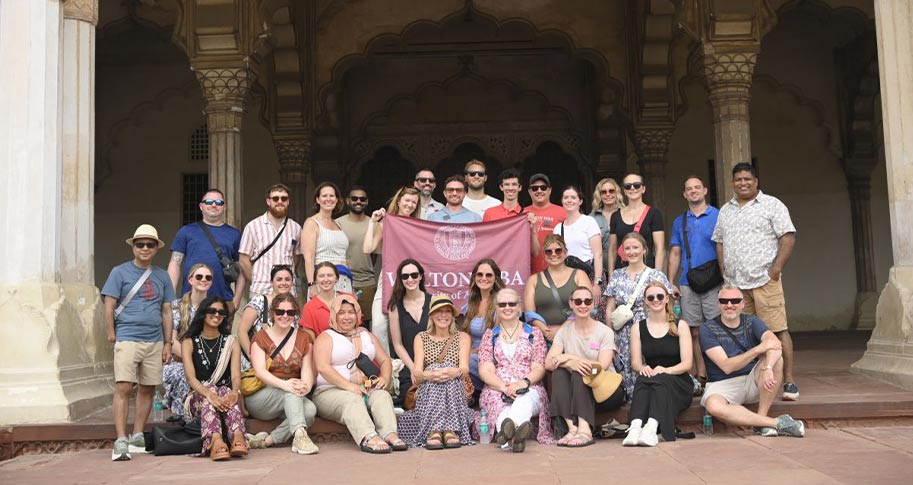
For future business leaders, understanding how global markets, cultures, and supply chains interact is essential. Our MBA students explore these dynamics firsthand through the Global Business course and its Global Immersion experience, an annual program that now takes place in India. This summer trip is a required component of both the Full-Time and Executive MBA programs, with each cohort traveling overseas to collaboratively solve a real-world business challenge. Along the way, students immerse themselves in new cultures and customs while sharpening their business skills.
What the Global Immersion Experience Provides for MBA Students
By traveling abroad and interacting with companies operating in international markets, students get a better understanding of how economic forces, culture, and policy all influence business decisions. Even for students who don’t plan to work internationally, the lessons are widely applicable. Modern supply chains span multiple countries, and companies increasingly rely on partnerships that cross geographic and cultural boundaries.
For many students, the immersion experience becomes a bridge between academic study and real-world application. “I would frame the India experience not as travel, but as executive preparation. India offers students a direct view into a market that is large, fast-growing, demographically powerful, and increasingly tied to U.S. trade and global business strategy,” said Mervin Jebaraj, who will lead this year’s immersion experience for Executive MBA students.
Why India Offers a Powerful Learning Environment
India’s economy remains one of the strongest among major countries, with the IMF projecting real GDP growth of 6.4% in 2026. At the same time, India’s population stands at roughly 1.48 billion, making it not only a large market, but a market of exceptional scale, long-term strategic relevance, and broad diversity of market segments.
“Our global immersion program in India offers students direct exposure to two of India’s most influential cities — Delhi, as the political capital of the most populous country in the world, and Bangalore, as the economic capital of one of the largest and fastest growing economies in the world,” said Rogelio Garcia Contreras, who will lead the 2026 immersion experience for full-time MBA students. “The course provides students with a firsthand insight into this powerful emerging market, deepening their understanding of foreign trade relations, multinational global supply chains, and the impact of local culture and global politics on short- and long-term decision making.”
With a growing population and rising household income, India is widely expected to become the world’s third-largest consumer market, behind only the United States and China. Executives must understand not just mature markets, but emerging demand patterns, evolving consumer aspirations, and the operational realities of serving a large and diverse customer base.
“The educational value of India lies in its combination of scale, speed, and complexity. India allows students to observe how firms compete in a price-sensitive but rapidly modernizing environment, how companies adapt to regional and cultural diversity, and how infrastructure, policy, and consumer behavior shape real business outcomes,” said Jebaraj.
Learning Directly from Global Companies
One of the most impactful elements of the experience is the opportunity for students to engage directly with companies working in international markets. “Our cohorts visit organizations ranging from Walmart Global Sourcing to Gokuldas Exports, TVS Motors, and NinjaCart. It shows students not just one India, but many Indias: manufacturing, technology, and agri-supply chain innovation,” said Jebaraj.
Through corporate visits and discussions with business leaders, students gain insight into how organizations scale operations, adapt to local markets, and maintain efficient supply networks. These conversations help students connect classroom concepts to real-world business strategy. “The experience strengthens global business acumen and prepares MBA candidates to lead effectively in an increasingly interconnected marketplace,” said Garcia Contreras.
Learn More About the Walton MBA Experience
If you’d like to explore how the Walton MBA experience can support your own leadership and career goals, we invite you to learn more about the Full-Time MBA at mba.uark.edu and the Executive MBA at emba.uark.edu.
 Jenni Wiltz is the Content Writer and Communications Assistant for Graduate Programs
and Research. She writes feature articles and press releases to promote the work of
students, faculty, and staff. Prior to Walton College, she worked as a Marketing Content
Manager for a financial planning and wealth management firm.
Jenni Wiltz is the Content Writer and Communications Assistant for Graduate Programs
and Research. She writes feature articles and press releases to promote the work of
students, faculty, and staff. Prior to Walton College, she worked as a Marketing Content
Manager for a financial planning and wealth management firm.