

Artificial intelligence is no longer just a technical capability—it’s a strategic imperative shaping how organizations compete, innovate, and grow. Yet the real challenge isn’t access to AI tools; it’s leading their adoption responsibly and effectively at scale. Walton College’s Master of Information Systems degree prepares students to do just that.
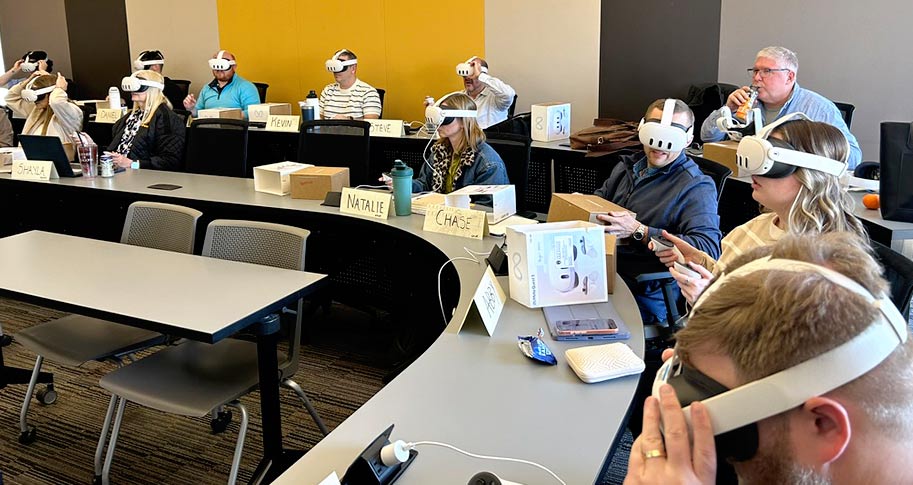
“Pursuing a Master of Information Systems (MIS) degree positions students at the critical intersection of business strategy and cutting-edge technology,” said Mary Lacity, the David D. Glass Chair and Distinguished Professor of Information Systems. “Students learn management practices designed to move innovations from proof-of-concept to live production implementations. By applying these principles to real-world case studies, such as Walmart’s use of AI chatbots to negotiate contracts or KLM’s use of extended reality for cabin crew training, students gain a blueprint for deriving actual business value from emerging technologies.”
Course Spotlight: Foundations of Digital Innovation
The program’s Foundations of Digital Innovation course launched in summer of 2024, with updates every semester as technology capabilities evolve. The course blends theory and hands-on practice focused on the most transformative technologies, including artificial intelligence, Web3, the metaverse (extended reality), and quantum computing.
The current version of the class focuses on the enterprise adoption of AI. Organizations adopt AI-enabled applications more slowly than individuals because they need to mitigate risks, comply with policies and regulations, and ensure that business value delivered outweighs the costs. To do this, they need principles, policies, decision-makers, processes, and infrastructure. However, AI model development outpaces these traditional forms of governance and employees have easy access to many AI tools, so organizations need new ways to foster innovation as well as contain costs and risks. This course teaches students about AI governance using current case studies as well as insight from world-class guest speakers from Gartner, Walmart, J.B. Hunt, Trinity Logistics, Ascension Health, IBM, KLM, FedEx, and more.
In addition to governance, students learn to apply innovation theories, ethical frameworks, and action principles to assess how digital innovations can deliver real business and social value. They also gain practical experience through interactive assignments, such as building a virtual gallery in a metaverse, creating digital wallets, and mastering RAG approaches to generative AI.
“My favorite part of teaching this course is witnessing the ‘wow factor’ during the final team presentations, where students conduct original research and interviews to tell punchy and powerful stories of real-world enterprise technology adoption,” said Lacity.
Poornima Malviya, a Walton College Master of Information Systems alumna with a concentration in Digital Innovation, praised the course’s combination of theory and practice. “What made this course especially meaningful was the balance between understanding the foundational concepts of AI—its evolution, impact, and real-world applications—and getting hands-on experience with emerging tools. We had the opportunity to experiment with AI platforms, build prototypes from simple ideas and sketches, and explore different coding and automation tools.”
Click here to learn more about the program, including application requirements, courses, program schedule, and more.
 Jenni Wiltz is the Content Writer and Communications Assistant for Graduate Programs
and Research. She writes feature articles and press releases to promote the work of
students, faculty, and staff. Prior to Walton College, she worked as a Marketing Content
Manager for a financial planning and wealth management firm.
Jenni Wiltz is the Content Writer and Communications Assistant for Graduate Programs
and Research. She writes feature articles and press releases to promote the work of
students, faculty, and staff. Prior to Walton College, she worked as a Marketing Content
Manager for a financial planning and wealth management firm.