

This article was originally published on LinkedIn.
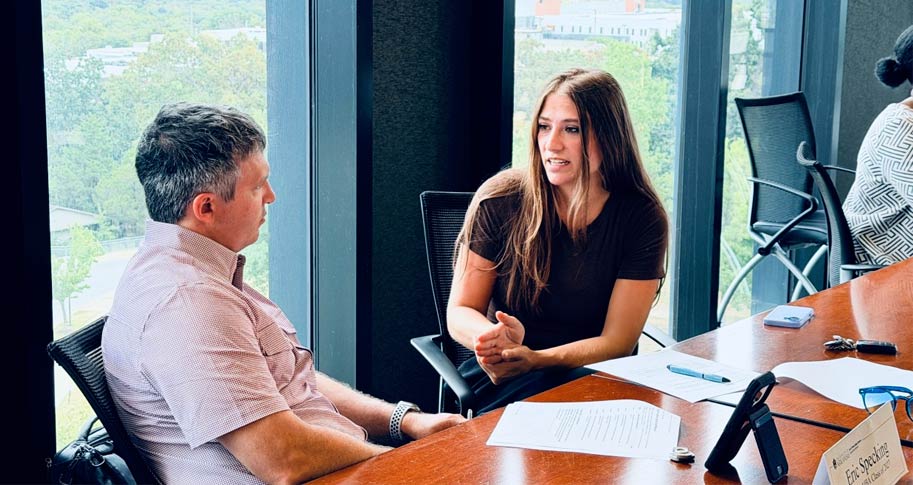
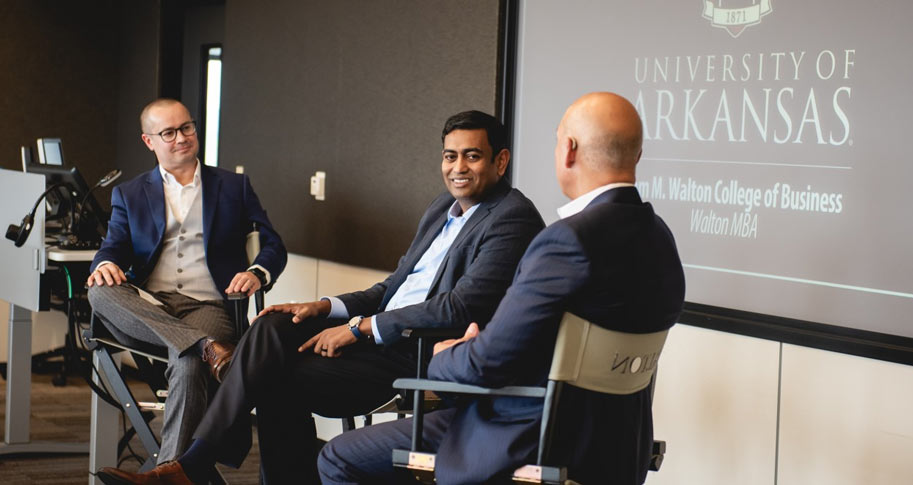
Oommen Thomas (OT), who goes by OT, earned his MBA at the Walton College and later returned to teach international supply chain to our undergraduate students. This month he returned once again, this time as Walmart's Senior Vice President of Global Supply Chain and Commerce Acceleration, to speak with the Executive MBA Leadership and Organizational Behavior class that Adam Stoverink, Ph.D., and I co-teach.
OT came to Bentonville 12 years ago as a consultant with Accenture, following his wife's career with Walmart. He later joined the company himself in supply chain in 2019. Today he leads global supply chain, real estate, and commerce acceleration, with his work focused on bringing Walmart's digital assortment to customers in markets beyond the United States. It is a role that requires him to keep learning, and much of our conversation centered on what that asks of a leader. Here are a few of my key takeaways from the conversation:
1. Competency gets you the job, but character earns the followership
I asked OT what keeps him up at night, especially after recently moving into a role with a significantly expanded scope. His career has been built in supply chain, strategy, and finance, and international real estate is new to him. He also had to build trust and influence with international partners in parts of the world and the business where he had never worked before.
What carries him through, he said, is remembering that he does not need to know everything to be successful. Competency is what gets a leader the job, but character is what earns the followership needed to do the job and lead the room. In a role where he cannot rely on expertise alone, the curiosity to learn the business and the character to earn people's trust matter more than having every answer from the start.
2. Surround yourself with leaders who know their business best
Leading in Mexico is very different from leading in China or the United States, and OT described each market and business as a completely different landscape. He cannot be the expert in all of them, so he surrounds himself with strong leaders who understand their own markets. Those leaders do not all need the same thing from him, either. The support he provides depends on the market and the situation in front of them.
3. Chase the scope and the role, not the title
Adam asked how OT keeps pushing himself to improve while leading the world's largest supply chain. His answer was to stay agile and chase scope and role rather than titles. When you stay grounded and curious, you find other ways to keep growing, whether that is a new market or a new leadership competency.
For OT, the competencies he has focused on most are communication and influence. He takes notes and practices before he presents, works on communicating clearly across languages and cultures, and treats his role, which requires influencing market CEOs, as constant practice. If you do not practice it, he said, you do not develop it.
He also keeps expanding what he knows by studying a completely different supply chain each year. He visits plants and factories and immerses himself in that industry to learn how it solves its problems. This year he chose life sciences and healthcare, and next year he plans to study automotive.
4. Let go of needing to be involved and needing to be right
I asked OT about the limiting beliefs described in one of the week's readings, The Hidden Beliefs That Hold Leaders Back, and whether he had faced any of them. He named two.
The first was "I need to be involved." Consulting trained him to walk into a room with a strong opinion and stay involved. As a leader, he learned that his job is to build the leaders on his team and trust them to run the business.
The second was "I need to be right." Some of the most fulfilling moments of his career have come when his team proved there was a better path forward than the one he had in mind. He still provides clarity and structure, but he gives his teams the space to find their own path and takes their feedback seriously.
Letting go of both beliefs also changed how he listens. Over time he has learned to only listen, without defending, justifying, or explaining. Then he follows up quickly after the conversation when he receives feedback, even when there is no outcome to report, because listening without action does not build trust.
The lessons we heard throughout the conversation were consistent: lead with character and curiosity, trust the people around you, and keep building the skills the next role will require, whatever its title.