


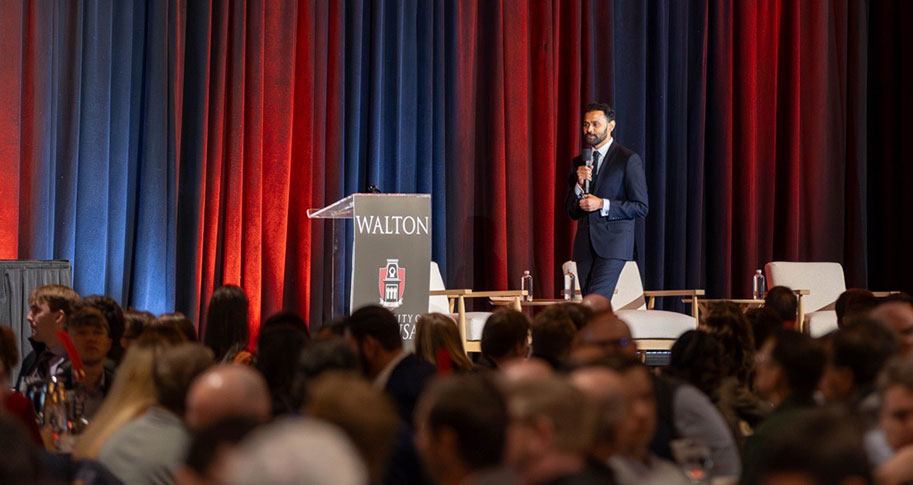
On January 30, the Sam M. Walton College of Business’s Center for Business & Economics Research hosted the 32nd Annual Business Forecast Luncheon. The keynote speaker was Alberto Musalem, president and chief executive officer of the Federal Reserve Bank of St. Louis. Mervin Jebaraj, director of the Center for Business and Economic Research, provided the state and regional forecast. The event was moderated by Matuschka Lindo Briggs, senior vice president and regional executive of the Little Rock Branch of the Federal Reserve Bank of St. Louis.
With tariffs, inflation, and a weak housing market topping national headlines in 2025, what did our forecasters see on the horizon for 2026? Let’s take a closer look.
The Big Picture: The World and Our Nation
In his presentation, Mervin Jebaraj predicted moderate world economic growth for 2026-2027. The current flurry of economic activity in the AI space benefits nations across the globe. However, Jebaraj noted, “A lot of growth coming from just one sector in AI means that if there’s any correction in that sector, it’s going to reverberate not just in the U.S. but across the world as well.”
Mexico and Canada, in particular, face a tough road ahead due to trade uncertainties with the U.S. India, however, remains poised to remain the world’s fastest-growing large economy in the next few years.
The overall forecast looks positive for the U.S. economy as well. Alberto Musalem described it as “resilient, with considerable momentum coming into 2026.” This year’s growth is predicted at or above the current rate, thanks in part to strong consumer spending and a steady labor market. Our current unemployment rate of 4.4% is near the level economists associate with full employment, and although there’s a risk of the labor market cooling, Musalem believes this risk has been decreasing. And although inflation is currently hovering at 2.8%, Musalem expects it to “resume a path towards our 2% target,” especially as tariff effects ebb later this year.
Other positive economic indicators include a buoyant stock market, widely available credit, and solid growth in bank lending and corporate debt issuance. Changes in tax law could lift spending even further in 2026. Productivity gains also have the potential to strengthen the economy. Many companies invested in automation during the tight post-pandemic labor market, and now, widening AI adoption has resulted in even further gains. However, a weak housing market may balance out the economic gains from increased spending and productivity.
A Closer Look: Our State, Our Region
In his regional forecast, Jebaraj notes that the Arkansas economy is growing at just above 3%, when measured without the agricultural sector. Ag is still experiencing losses from reduced exports and higher input costs, although the impact of 2025’s tariffs should lessen in 2026. Other sectors that have seen a decline in 2025 include government (driven by federal staffing cuts) and construction. Growing sectors – especially in central Arkansas – include healthcare and leisure/hospitality. For Arkansas as a whole, Jebaraj predicts a moderate growth rate of 13,000 new jobs in 2026, slightly lower than the 15,000 the state gained in 2025.
Population growth and housing affordability continue to be hot topics in Northwest Arkansas. That growth is expected to continue, with about 28 people per day moving to the region. Although recent data indicates an overall growth rate of 13,700 people per year, Jebaraj estimates that rate will drop slightly, returning to levels seen in 2021. Home sales have remained steady despite price increases and higher mortgage rates than in 2020 and 2021. As neither rates nor prices appear likely to decrease in 2026, cities will need to improve zoning and upgrade water-sewer infrastructure if they want to increase their supply of homes and take steps toward increasing affordability for new and current residents.
Musalem described his outlook for our region as “cautious optimism.” One of the reasons for that caution? While the region added 11,000 jobs in 2024-2025, only about 9,000 are expected in 2026-2027. Sectors that will continue to experience job growth include professional business services – still the fastest-growing sector in Northwest Arkansas – as well as leisure/hospitality and healthcare.
Of his fourth visit to Arkansas, Musalem said, “I come here and I learn not just local and state economics. I learn about the national economy and the world because of the broad reach companies in this part of the state have. This has been a very productive trip because I come away with a lot of insights that help me in my job.”
Photo: Sydney Acevedo
 Jenni Wiltz is the Content Writer and Communications Assistant for Graduate Programs
and Research. She writes feature articles and press releases to promote the work of
students, faculty, and staff. Prior to Walton College, she worked as a Marketing Content
Manager for a financial planning and wealth management firm.
Jenni Wiltz is the Content Writer and Communications Assistant for Graduate Programs
and Research. She writes feature articles and press releases to promote the work of
students, faculty, and staff. Prior to Walton College, she worked as a Marketing Content
Manager for a financial planning and wealth management firm.