

This article was originally published on LinkedIn.
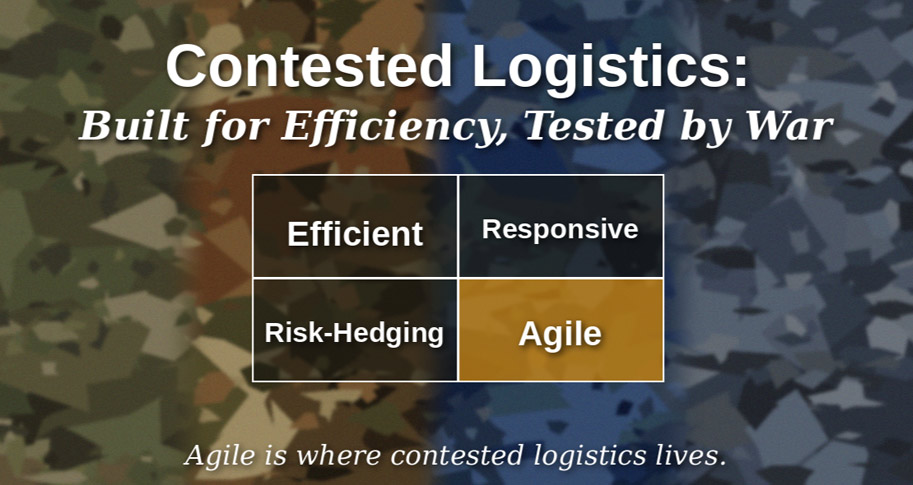
Contested logistics: two themes
One is sensing and decisioning: precision sustainment powered by AI and data. The other is sustaining dispersed formations without relying on stationary, fixed facilities.
Put those together and you reach an uncomfortable conclusion:
When the environment is denied, disrupted, and lethal, the decisions about replenishment, commitment, and node operations matter as much as the vehicles that move the supplies.
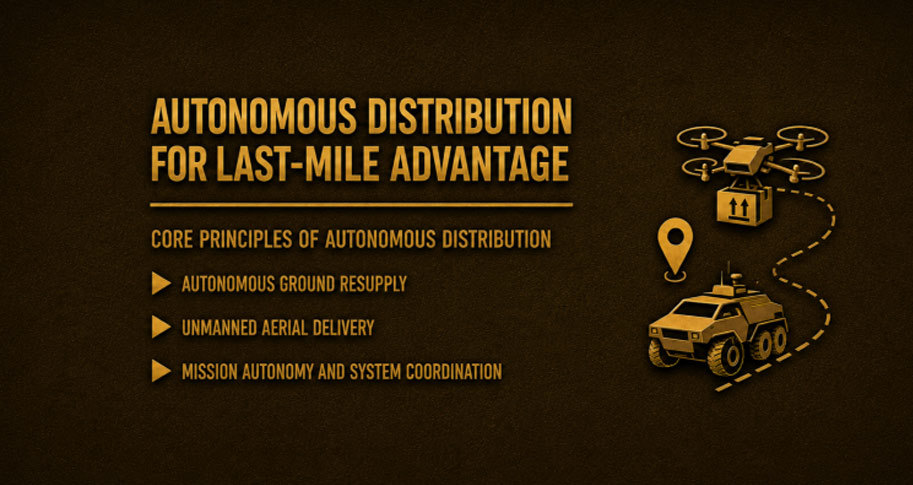
Most contested logistics conversations focus on platforms: autonomous trucks, delivery drones, robotic resupply. Platforms matter.
But platforms operate inside a decision architecture. If that architecture is flawed, better platforms simply move the wrong supplies to the wrong place faster.
Most of my career I've focused on industrial logistics and supply chain management. Recently, I’ve been studying contested logistics and working through four supply chain concepts (Vendor-Managed Inventory, postponement, cross-docking, and human-in-the-loop autonomous material handling) and applying each to the contested sustainment problem.
What surprised me is how tightly they interlock.
Together, they form a single operational logic.
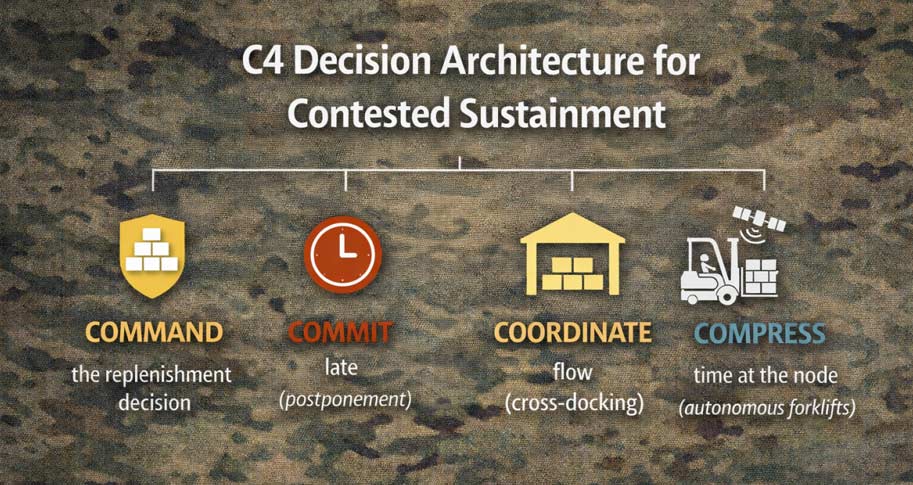
The C4 Decision Architecture
Command. Commit. Coordinate. Compress.
This is a way to design sustainment that remains coherent when the enemy is actively trying to break it.
1. Command the Replenishment Decision
Decision rights, visibility, smoothing
VMI is widely misunderstood as “the vendor orders for you.” At its core, it is about decision rights.
Who should make the replenishment decision? Based on what visibility? With what authority?
When fragmented nodes order independently under uncertainty, demand distortion is inevitable. In contested sustainment, distributed units facing uncertain lead times and high consequences will over-order. That is not indiscipline. It is rational risk behavior.
The problem is what happens in aggregate.
When every battalion hedges independently, the demand signal amplifies. This is bullwhip under fire. It consumes throughput capacity that should be reserved for actual combat demand.
The answer is not to bolt AI onto a fragmented ordering system.
It is to design decision ownership deliberately:
- Clarify which decisions sit at unit, brigade, sustainment brigade, or theater
- Build minimum viable consumption visibility that survives degraded communications
- Use enterprise-level coordination to smooth variability and enforce allocation guardrails
When the system is stressed, uncoordinated local optimization becomes system-wide failure.
Command means designing the decision structure before the stress arrives.
2. Commit Late
Postponement as risk positioning
Postponement delays irreversible commitments (to form, configuration, or destination) until better information arrives.
In commercial settings, postponement reduces the cost of being wrong about demand.
In contested sustainment, the cost of being wrong is signature, vulnerability, and lost flexibility.
Every forward push is a bet:
- A pallet of ammunition sent to one axis of advance
- A medical resupply package configured for one unit
- A fuel push to one forward location
If that bet is wrong, repositioning it costs time, transport, exposure, and risk.
Postponement reframes forward positioning as a risk decision:
- Keep inventory generic longer
- Delay kitting and final-mile allocation
- Use movement windows to make late commitment feasible
The tradeoff is real.
Lower vulnerability versus longer response time.
The objective is not maximum postponement. It is the point where the marginal survivability gain equals the marginal responsiveness loss. That point shifts by commodity, threat, and operational phase.
3. Coordinate Flow
Nodes as coordination points, not storage points
Cross-docking reframes what an intermediate node does.
It does not have to accumulate inventory. It can coordinate flow.
Inbound arrives. It is reconfigured. Outbound departs. Minimal dwell.
Contested environments punish storage and reward flow.
But cross-docking forces an uncomfortable truth. Removing buffer stock from intermediate nodes can lengthen effective lead time to forward formations unless time is compressed elsewhere.
If that lead-time effect is ignored, risk does not disappear. It migrates forward.
Cross-docking works in contested sustainment only if:
- Allocation logic functions even with partial visibility
- Forward organic loads are sized for the new replenishment cycle
- The node is engineered for speed-through, not parking-lot dwell
Cross-docking is not “don’t stock.” It is “don’t create stationary jackpots.”
4. Compress Time at the Node
Autonomy as execution accelerator
Human-in-the-loop autonomous material handling is often framed as labor reduction.
That framing misses the point.
Its real value is cycle-time compression and throughput reliability.
Autonomous systems handle predictable volume. Remote teleoperators resolve exceptions. Inventory location accuracy improves. Surge capacity becomes a network resource rather than a local constraint.
In contested sustainment, every hour a node operates is an hour it is visible and targetable.
Time at the node is risk.
Compression accomplishes three things simultaneously:
- It makes cross-docking viable
- It makes postponement viable
- It makes command-level orchestration actionable
Decisions only matter if execution can keep pace.
Why the Four Must Work Together
Each C solves a different failure mode. More importantly, each enables the others.
- Without Command, the network tears itself apart through demand noise.
- Without Commit, the system over-bets early and locks itself into vulnerable positions.
- Without Coordinate, nodes accumulate mass and become targets.
- Without Compress, flow stalls and everything else degrades.
The interdependence matters.
An Army that builds excellent autonomous platforms but does not redesign decision rights will move the wrong supplies very efficiently.
An Army that embraces postponement but cannot compress node throughput will delay commitment and miss delivery windows.
An Army that designs flow nodes but cannot smooth inbound variability will build cross-docks that alternately starve and flood.
The architecture works as a system. Or it degrades as a system.
Closing
Contested sustainment will not be solved by a single breakthrough platform or a single optimization algorithm.
It will be solved by a decision architecture that consistently answers four questions under pressure:
Who decides? When do we commit? Where do we coordinate flow? How fast can we move through the node?
Which of the four Cs is strongest today? And which still defaults to storage-first thinking?